
Duncan Thomas, Co-Founder, CEO and Head of Innovation at Pomegranate
Most consumer health brands treat a weak conversion curve as an evidence problem, and answer it with more proof. But the reality is that evidence doesn’t create the decision to buy; it only gives the customer permission to act on a decision already forming, which is why the same clinical trial reassures one buyer at the point of commitment and reads as a sales pitch to another three clicks earlier. In this blog, Duncan Thomas, Founder of Pomegranate, breaks down what that means in practice.
The problem is rarely the strength of your evidence, it’s where that evidence sits, and the costliest gap of all comes after purchase, where 51% of consumers have already walked away from a product they couldn’t tell was working
In this article
- What a 1981 BMJ study proves about branded evidence
- The five types of proof in a consumer health journey
- How buyer motive changes the evidence you need
- Why half of UK consumers stop using a health product
- Do certifications and seals do the work on their own?
- Why sequence matters more than the strength of your evidence
The consumer health industry has never held more proof. Published trials, USP seals, NSF certifications, practitioner endorsements, traceable supply chains. Yet conversion curves and month-three churn tell a different story. The problem is rarely the evidence itself. It is a misunderstanding of what evidence actually does in a buying journey. Here is the position we want you to test against your own funnel: proof does not persuade; it permits. The decision to buy a health product forms emotionally, from desire, identity and hope. Evidence does not create that decision. It removes the barrier to acting on a decision already in motion. Deploy it before desire exists, and you trigger scepticism. Withhold it at the moment of commitment, and the purchase quietly dies.
Most brands do not have a proof problem. They have a proof application problem.
What a 1981 BMJ study proves about branded evidence
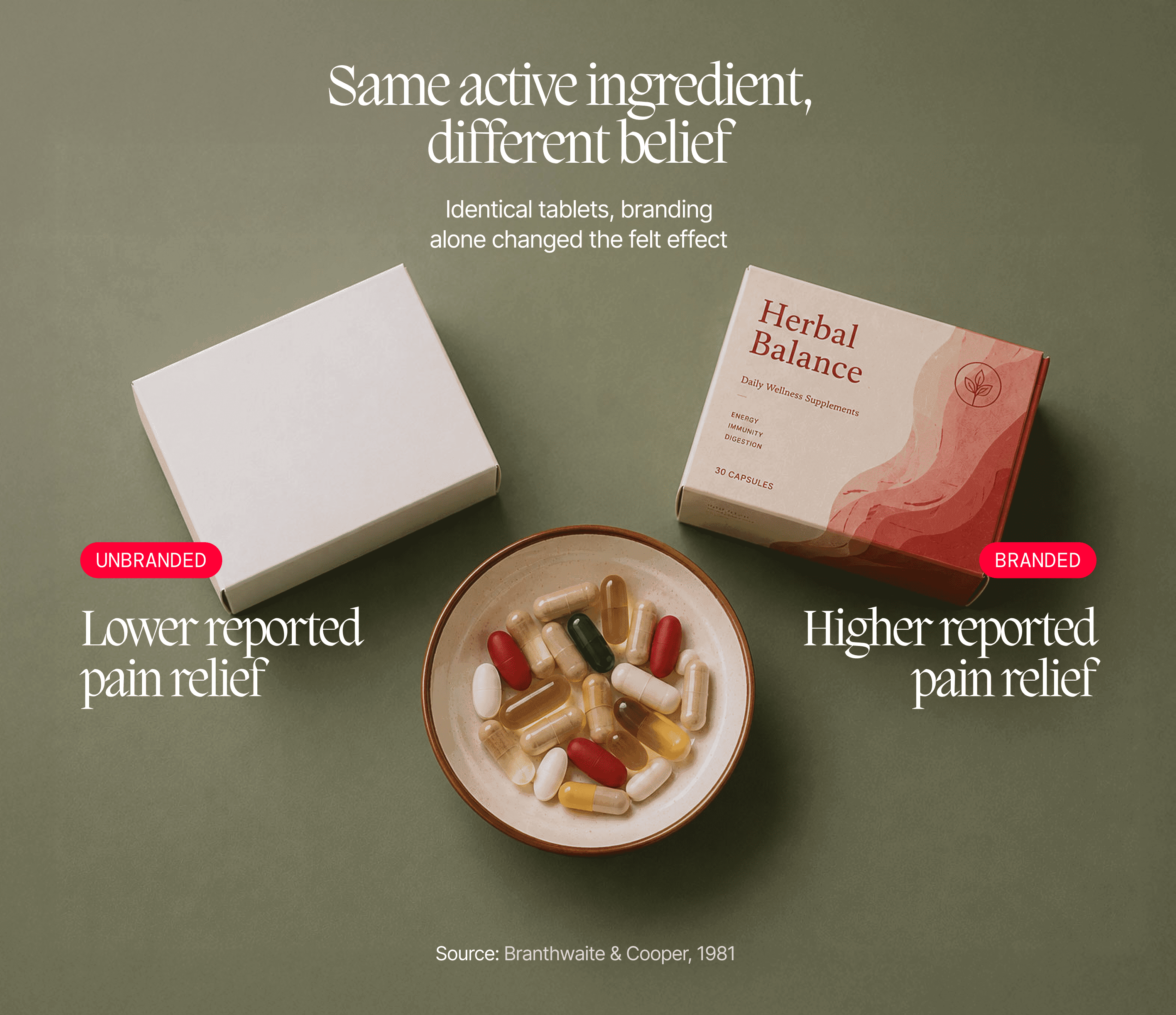
In 1981, the British Medical Journal published a study by Branthwaite and Cooper that should be pinned above every consumer health marketer’s desk. Women with headaches were given branded or unbranded tablets, containing either a real analgesic or nothing at all. Branded tablets significantly outperformed identical unbranded ones, and the branding effect was strongest in the placebo group. The researchers attributed it to confidence: belief in the brand produced measurable relief.¹
The context around the evidence changed how the product actually felt. Proof is an experience, and its effect depends on the emotional state the customer is in when they meet it.
The five types of proof in a consumer health journey
Proof is not a message. It is an architecture. Our own research confirms this is not a historical curiosity. In the consumer health trust study we published this year, the three top factors when choosing a new health product sat almost level: evidence of tangible health benefits (49.5%), positive reviews from other users or someone they know (44.7%), and clear scientific evidence such as clinical trials (44.1%).² These are not three separate demands. They are three forms of the same question, asked by different people in different emotional states: will this work for me?
The consumer health trust study is self-reported, from a paid panel of 188 digitally active UK consumer health users aged 18 to 44.
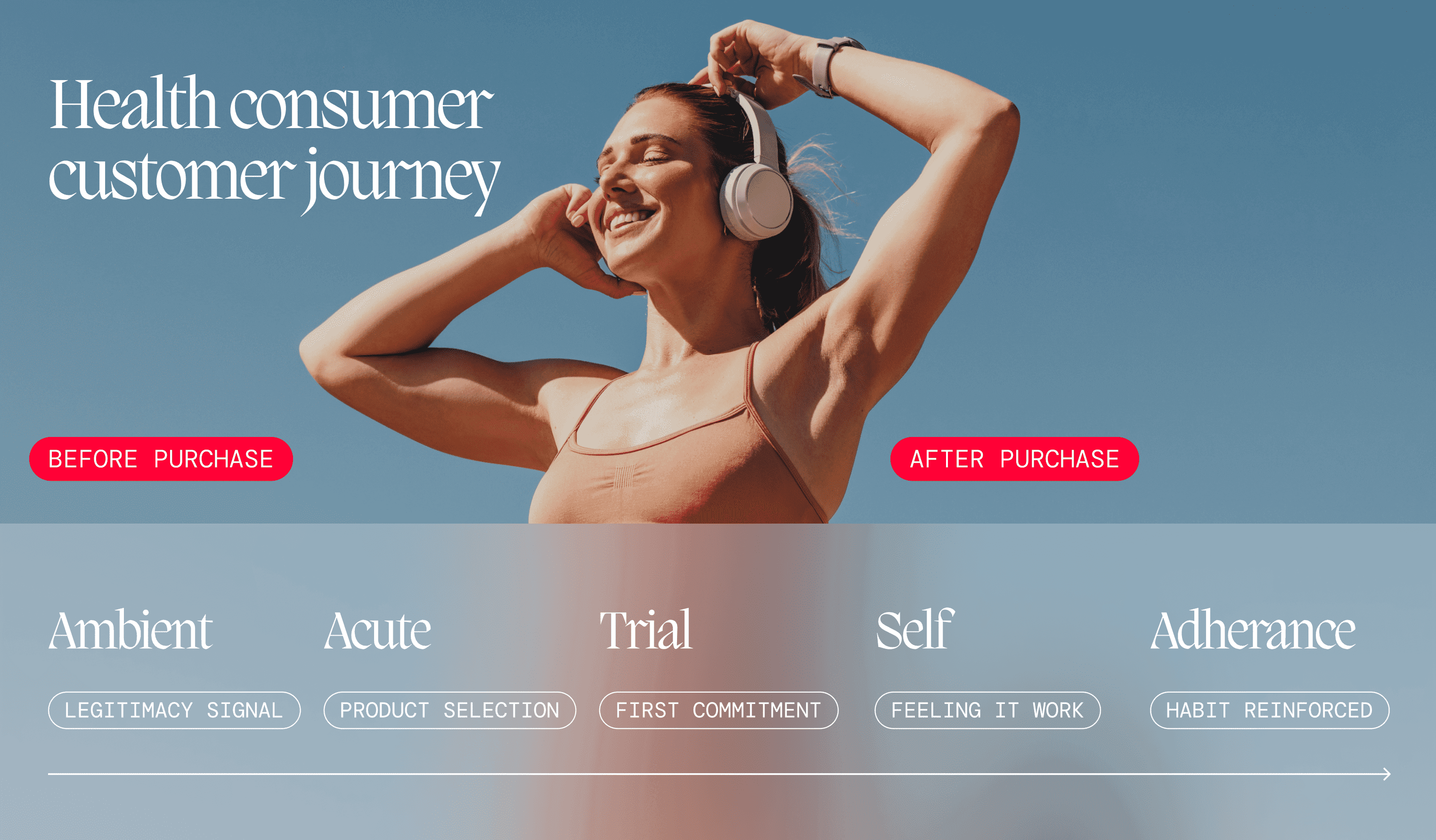
This is why proof cannot be one thing deployed at one moment. Across the customer journey, it does at least five distinct jobs, and the type, dose and format must change at each:
- Ambient proof works early, before the customer has consciously asked whether you are legitimate. Headline signals only: a seal, a practitioner association, visible adoption.
- Acute proof works at product selection, the true permission moment, where the mechanism, the study and the differentiator earn their place.
- Trial proof lowers the risk of first commitment.
- Self proof helps the customer feel the product working after purchase.
- Adherence proof keeps reinforcing the choice until the behaviour becomes habit.
Three strong operators weight this architecture differently:
Thorne builds through a cascade of institutionally respected sources, anchored by a Master Clinical Study Agreement with Mayo Clinic and trust from more than 46,000 healthcare professionals.³
Momentous plays the elite validation game: patented, clinically studied ingredient forms, NSF or Informed Sport certification across the range, a named scientific advisory bench, and partnerships spanning more than 175 professional and collegiate sports programmes.⁴
DR.VEGAN plays a different role in the architecture: trial proof. Its money-back guarantee isn’t one-size. The refund window varies by product, calibrated to how long that formula is expected to take to deliver a benefit, so the risk period matches the body’s actual timeline rather than an arbitrary industry standard.⁵
All three are superb at granting permission. But none of them creates desire with evidence. Desire comes from somewhere else entirely, and the smartest brands know it.
How buyer motive changes the evidence you need
Proof also needs to match why the customer is buying, not just where they are in the journey. Get this wrong and the same evidence either works or backfires, depending on the motive it meets.
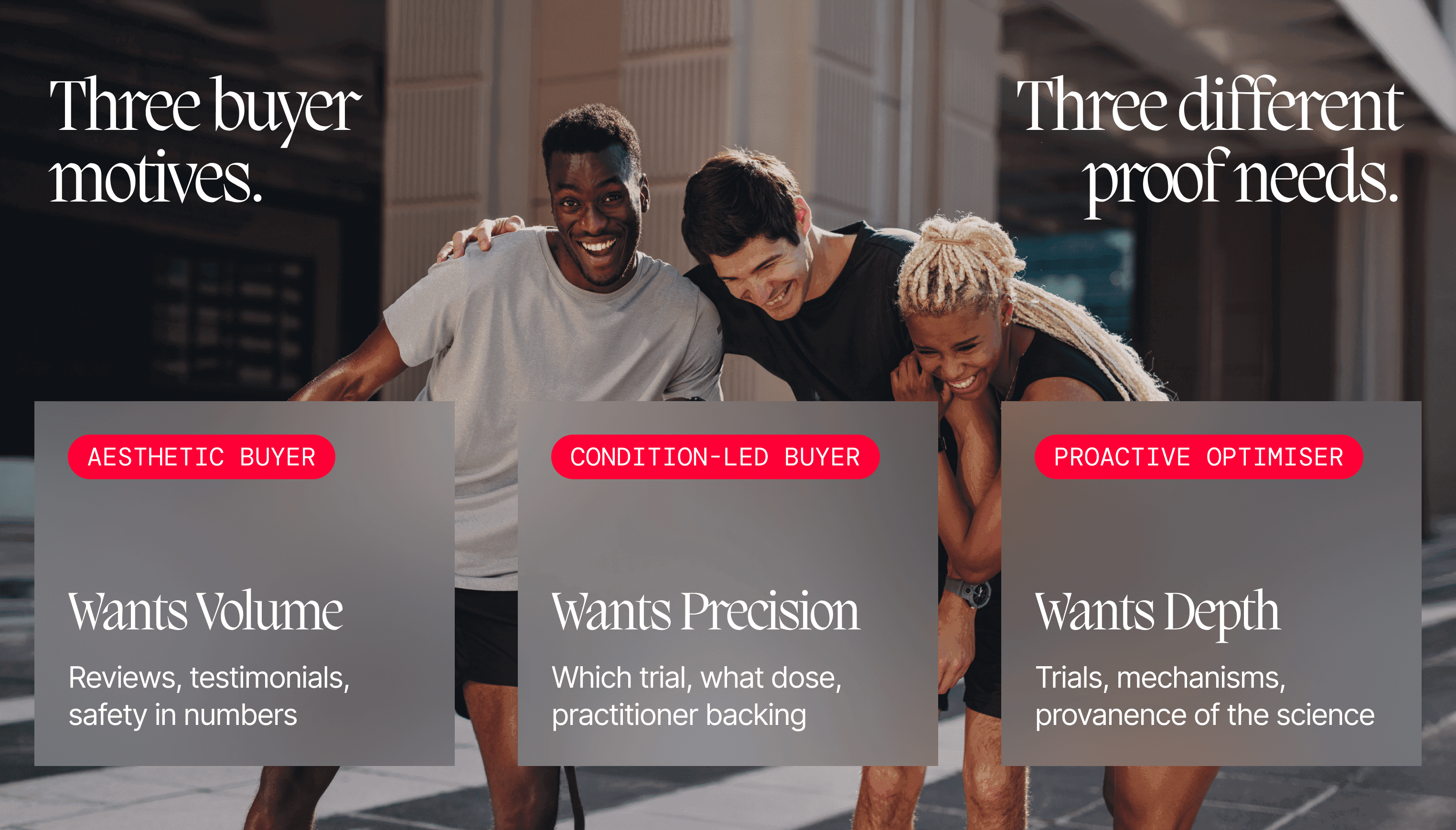
The aesthetics buyer, buying to look good, wants volume: reviews, testimonials, safety in numbers. Serve them a meta-analysis, and you create friction where none existed.
The proactive optimiser, engaged with the evolving science and playing deliberately with their own biology to protect quality of life, wants depth: trials, mechanisms, the provenance of the science. Serve them five-star reviews, and they’ll assume you have nothing stronger to offer.
The customer resolving a health condition sets the bar highest of all. The stakes are personal and the risk of getting it wrong feels real, so volume and mechanism explanations aren’t enough on their own. This buyer wants precision: which trial, on whom, at what dose, and ideally some practitioner-level signal standing behind it. Thin proof here doesn’t just fail to reassure. It reads as the brand not taking the condition seriously.
The same product and the same evidence base can serve all three. The proof either permits or blocks, depending on the motive it meets. You can’t sequence proof correctly until you’ve diagnosed the desire it has to serve.
Why half of UK consumers stop using a health product
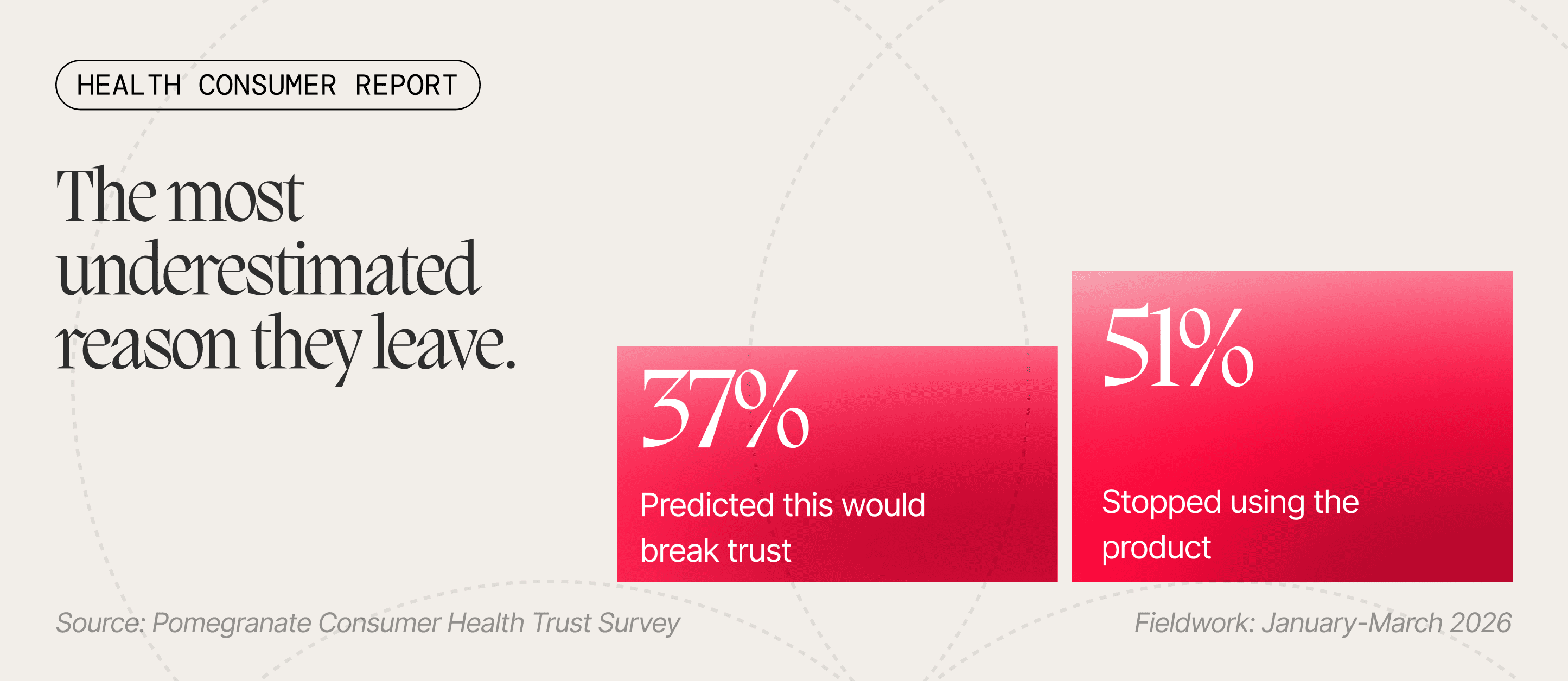
Only 37% predicted that a lack of results would be the thing to break their trust. Yet 51% told us they had, at some point, already stopped using a health product because it failed to deliver results.² Outcome disappointment is the most under-feared exit trigger in the dataset, and it is where supplement economics quietly bleed out.
The reason is structural. Most supplement benefits are cumulative, subtle and invisible. As one of our street interview participants put it: "If you can actually feel what it does! That’s the key thing, you know it’s working." And the silent churn version, from another:
Sometimes I feel like it doesn’t do anything to me, and I’m like, okay, maybe I should not be taking it. -Pomegranate street interviews, January to March 2026-Pomegranate street interviews, January to March 2026
This is where the most sophisticated proof in the journey lives, and in our experience almost nobody designs for it.
The science here is remarkable. In Ted Kaptchuk’s landmark trial, patients were told plainly that their pills contained no active medication, but that pills like these had been shown in prior research to trigger real, measurable improvement through the body’s own response to expectation and ritual.⁶ The ritual of taking the pill, and the expectation it creates, produced a genuine physiological response even though the patient knew there was no drug inside it. Knowing the truth did not cancel the effect. Patients still reported significant symptom improvement, a result since confirmed across other conditions by meta-analysis.⁷ Honest information about how expectation affects the body turned out to be, in itself, a kind of active ingredient.
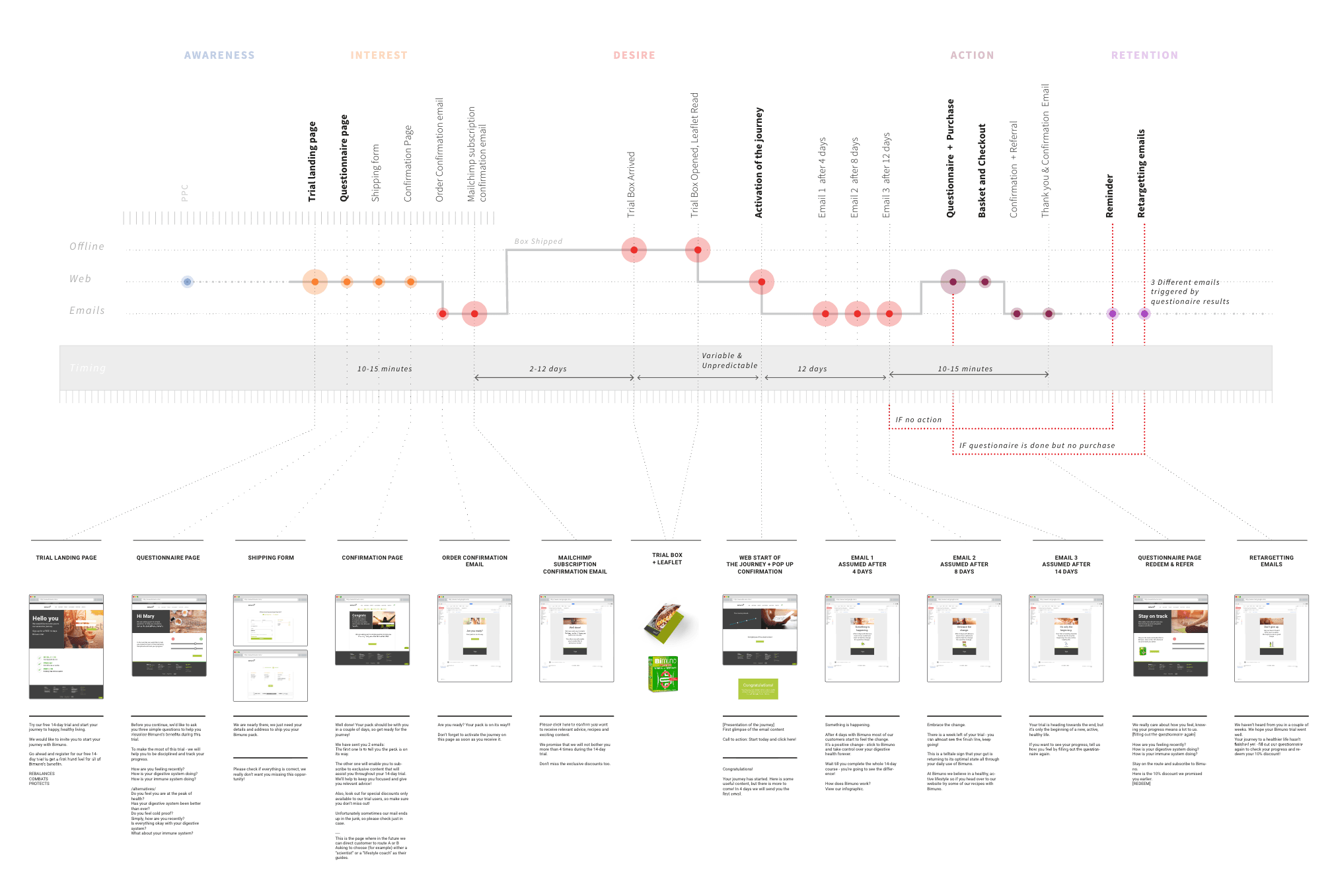
We applied this principle with Bimuno, a prebiotic whose effect cannot be directly seen or felt. The work was not to assert efficacy harder but to narrate it: telling customers what the science shows is happening inside the body at each key stage, using visual mechanics that connect the brain to physiological change it cannot otherwise perceive. Self-proof is proof the customer generates. It converts a claim into an experience, and experience is what survives month three.
Do certifications and seals do the work on their own?
The objection we hear most from CMOs runs like this: customers cannot read a clinical paper anyway, an FDA approval or NSF seal is all they look for, and new evidence is slow and expensive. Every part of that observation is correct, and yet the conclusion drawn from it is wrong.
The badge working without being read is not evidence that proof does not matter. It is evidence that proof functions as permission, not persuasion. Certifications and seals do real work for brand perception even when most buyers never examine what stands behind them.⁸
But the badge only works for the first purchase. At week six, when the customer feels nothing, they quietly stop buying.
Evidence can also go stale. We have worked with a pharma brand holding a genuinely rare regulatory approval whose conversion still flattened. The evidence was true. It just was not current any more. Where practitioners are part of your advocacy, proof has to stay current or it stops doing its job.
The real cost to most brands isn’t running new trials. It’s failing to place the proof they already have at the right moments.
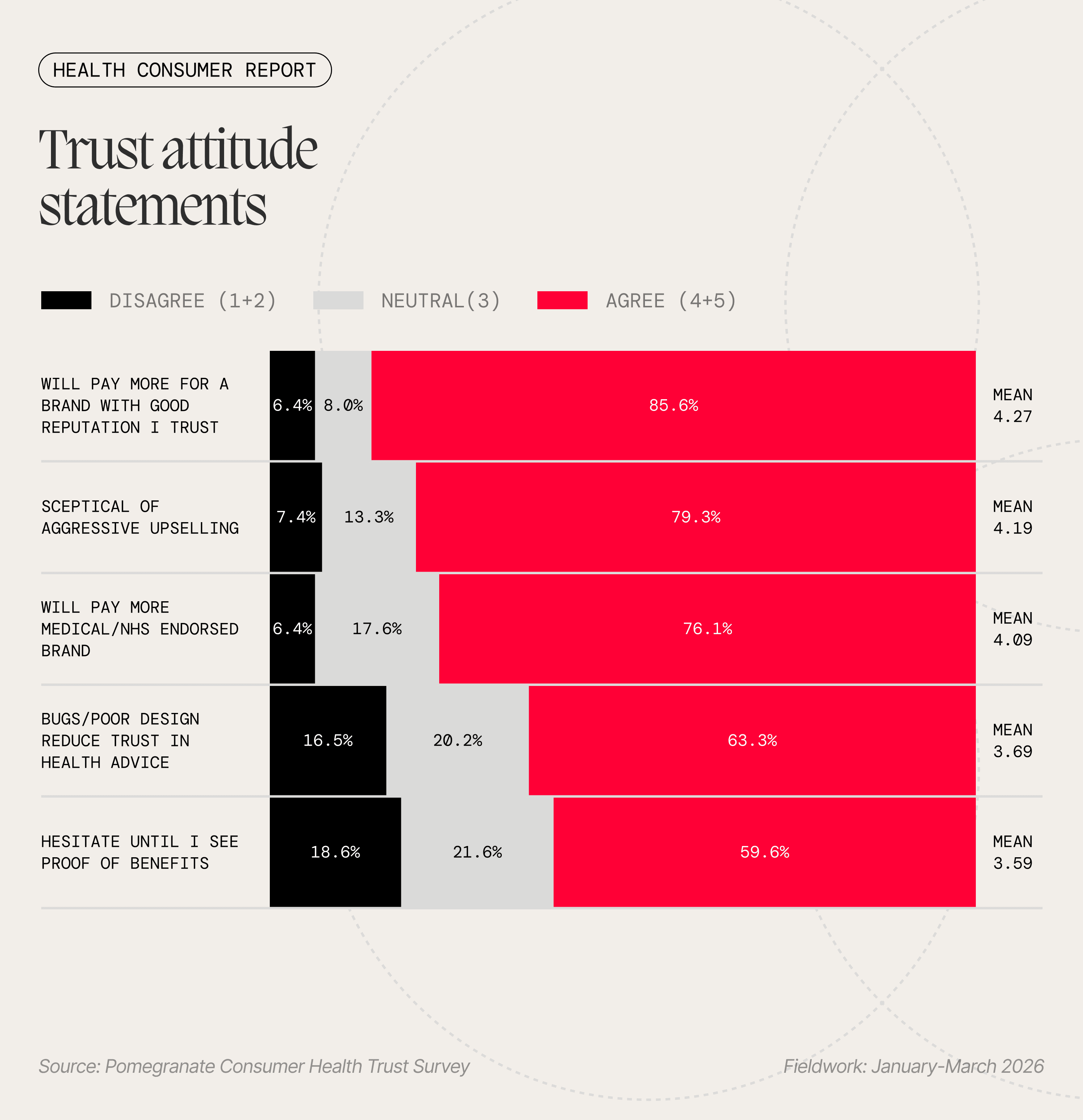
Our research puts the commercial stakes plainly: 85.6% of consumers will pay more for a brand they trust, while 79.3% grow sceptical the moment a brand feels aggressively sales-led. Consumers told us, in their own words, to establish value and trust first, then sell. They are asking for the right order. Almost nobody is giving it to them.
Why sequence matters more than the strength of your evidence
Proof is critical, but the sequence cannot be ignored. Efficacy will only become more important as customer cynicism rises. But efficacy alone earns nothing. What determines whether your evidence converts is whether it is accessible when the customer needs it, understandable in a form they can feel, and positioned at the right moment, in the right format, in the right emotional state.
That discipline is the piece almost every consumer health brand ignores, because it lives not in the evidence library but in the design of the experience.
Most brands miss this twice over. They under-design where and how proof markers actually appear, and they ignore the value sitting inside the trial and the onboarding period, where data gathered from the customer can be fed straight back to them, reinforcing belief in the effect as it happens through their website, marketing automations and digital marketing.
You have spent years and millions proving your product works. Have you spent anything helping your customer feel ‘permitted’ to believe you?
If you want to improve the design of your customer permission journey, and develop your relationships around sustainable trust, let us show you the new realm of experience design.