
Duncan Thomas, Co-Founder, CEO and Head of Innovation at Pomegranate
Most health brands will read the headline ‘Nearly four in five are sick of health brands’ hard sell’ as a bold instruction to sell less and soften their tone across their website and marketing communications. But the reality is that people aren’t objecting to being sold to; they’re objecting to being sold to before of value is given, and that is a question of where commercial intent sits in a customer journey rather than how the copy is written. In this blog, Duncan Thomas, Founder of Pomegranate, breaks down what that really means for health brands.
Consumers are not objecting to being sold to, they are objecting to being sold to before any real value has been given, and to being asked to reveal so much about themselves without ever being told why. Both of those are design decisions, which is the uncomfortable part, because it means the problem was never the tone of the copy.
In this article
- Why health buying doesn’t work like retail buying
- The tactics that only work if the buyer is worried
- The health quiz that can never say no
- Four trust failures in one live health journey
- What consumers asked health brands to do differently
- Why the answer isn’t selling less
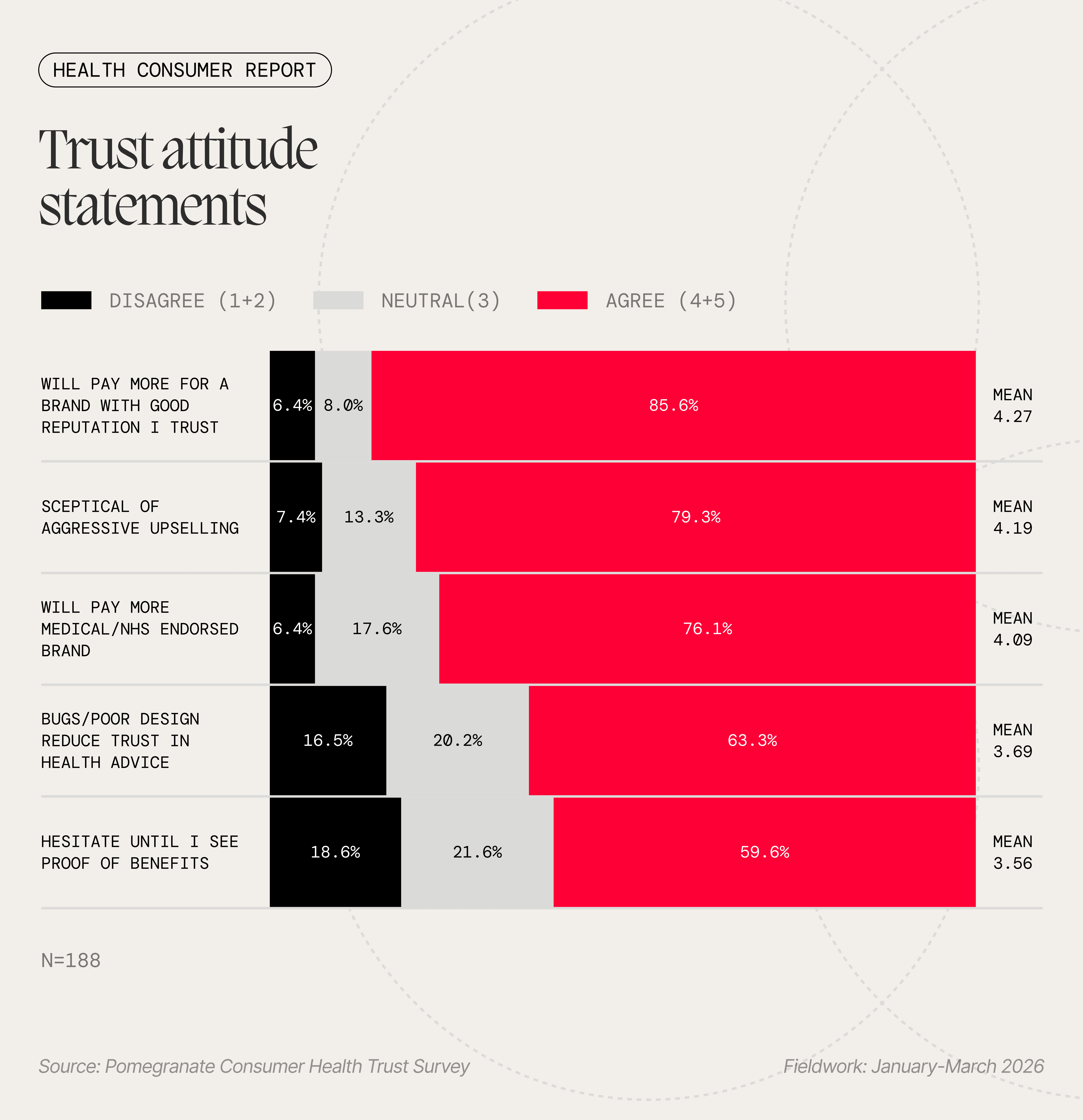
Every consumer health brand should have two stats pinned above its roadmap. First, 85% of engaged health consumers say they would pay more for a brand with a good reputation they trust.1 That is the premium: available, measurable, and what most acquisition strategies are implicitly chasing. Second, 79% of those same people become more sceptical the moment a brand seems to be pushing for the sale.¹ That is the blocker. Pushing tells people the brand’s interest has moved from their outcome to its sale.
The consumer health trust study is self-reported, from a paid panel of 188 digitally active UK consumer health users aged 18 to 44.
So brands are not choosing between growth and trust. They are funding one by spending the other, reaching for the tactics that capture the premium without noticing they are the same tactics that dissolve it. The cost is real, and it never shows up on the dashboard.
Dig deeper into the data, and a single, reasonable request emerges. Just over half, 51%, say personalisation turns intrusive when recommendations feel driven by selling rather than health. For 35% it turns intrusive when the tone becomes pushy, judgemental or alarmist, and for 29% when recommendations arrive too frequently.¹
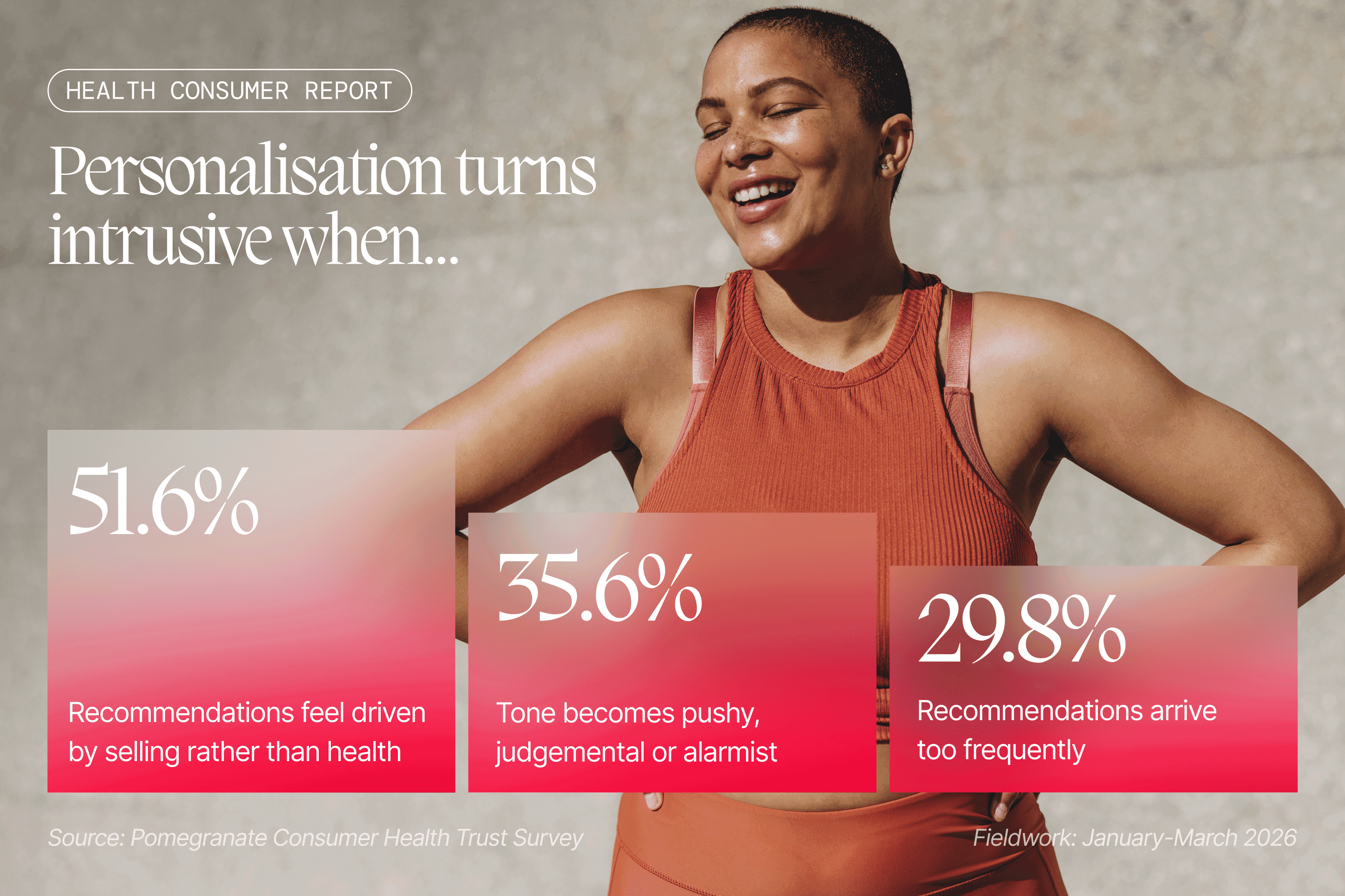
Each describes the same moment: someone can see the commercial machinery working and cannot see what they get in return. Which means the premium relationship and the blocker are not two findings; they are one instinct seen from two sides.
People will fund a relationship they believe is reciprocal. They will not fund one that only extracts.
Why health buying doesn’t work like the retail buying journey
The conversion approach most health brands are running was written for a market where anything delaying checkout is correctly treated as friction. In retail, that logic is sound. The decision is fast, the stakes are low, and streamlining genuinely serves the customer as well as the seller.
Three things change in health. The downside of a wrong decision is asymmetric: a misjudged retail purchase costs money, a misjudged health purchase can cost months of a condition going unaddressed, so vigilance rises accordingly.
The decision is often made from a position of uncertainty or discomfort, which raises sensitivity to anything resembling pressure.
And health borrows its authority from medicine, where nobody expects to be upsold. When a pharmacist recommends something, the recommendation carries weight precisely because it is not understood as a sales act; that authority sits in consumer health too. Our research values that inherited authority: 76% would pay more for a brand endorsed by the NHS or a medical professional.¹
Imported into health, the retail definition of friction cannot tell the difference between friction that costs a sale and deliberation that earns one. Under pressure to sweat the marketing activity, what gets cut is predictable, and it is rarely anything a team would defend losing if the decision were made out loud.
Emotional depth and personal value are being dangerously dispensed with for the sake of the quick win. The pressure to sweat the asset means anything slowing the funnel gets stripped out, so segmentation, onboarding and explanation are the first things cut. Those are precisely the things that build confidence in a health decision. What survives is a fast path with no empathy in it.
Health brands inherit medicine’s authority and then spend it on mechanics built for a market with none of these conditions. Retail has taught health brands a great deal, but the transplanting has now gone far enough.
Consumers’ decisions require emotional responsibility and genuine support, because people are deciding what to put in their bodies.
The tactics that only work if the buyer is worried
Aggressive sell versus gentle nurture is the wrong question. The one worth asking is which of your tactics would survive a customer who was not feeling any real concern.
The research points to a group of consumers who reject aggressive or shame-based marketing, and communications that read as pushy, judgemental or alarmist. Some of what they are rejecting is simply out of place. Urgency countdowns and cross-sell were built for retail, where they work, and where nobody minds much. Move them into health and they misfire, but the fault is in the transplant rather than the tactic.
Confirm-shaming someone about their own body is a different case. It was never neutral, and it is no longer even novel: the tactic peaked in the Tumblr era around 2016, and by 2019 researchers were cataloguing it across thousands of shopping sites as documented practice.² Alarmist framing has no retail equivalent at all, because retail has no equivalent anxiety to convert.
That is the real distinction. Urgency and cross-sell misfire in health. Confirm-shaming and alarmist framing do the opposite: they only function here, because health is the one market that supplies what they run on. A brand using them is monetising the same fear it claims to be treating. That is the line worth drawing. Not how hard you sell, but whether the sale needs the person to be afraid.
The most widespread version of this is also the most elaborate, and the most likely to be sitting on a brand’s own site right now.
The health quiz that can never say no
The health quiz is built to present a brand that cares, one seriously trying to diagnose and help, when very often it turns out to be something else.
What gives it away is that the output cannot vary in any way that matters. Of the many we reviewed across personalised vitamins, protein, and sports supplements, only a handful could conclude that someone’s regime was already adequate and that no product was needed.
A quiz that can never say no is not an assessment with a commercial outcome attached. It is lead capture wearing a lab coat.
People feel the cost of this directly. Nearly half, 49%, say personalisation turns intrusive the moment it draws on data they did not realise they had shared,¹ and a long assessment is an efficient way to collect precisely that while appearing to offer a service in return. One street interview participant described what the format does even when it works exactly as intended:
“It gives me pressure..if someone made a plan for me” – Street interview, Building Trust in Consumer Health, Pomegranate 2026
The discomfort does not come from any single question; it comes from the cumulative shape of the set. Sleep, energy, focus, digestion, stress, recovery: every item is a possible deficit, and by the end the person has been walked through an inventory of everything that might be wrong with them. The product then arrives as relief from a problem the questionnaire assembled.
So the quiz itself is not the problem. Built with real integrity, it can deliver practical insight and an honest answer, including no. The difficulty is holding attention and starting a useful interaction while navigating someone’s emotions responsibly.
Four trust failures in one live health journey
Our experience design team recently ran a behavioural audit of a consumer health brand’s digital experience. Almost nothing we found was a budget constraint, and most issues identified came down to a choice about where commercial intent sat.
The reason to care sat below the transaction. The emotional hook, the account of what the product changes and why it matters, appeared underneath the product grid and the buy mechanism. The pages often led with the ask and explained the value afterwards, which inverts the sequence that works for health consumers.
The endorsement section read as users and was in fact investors. Recognisable names presented as advocates, with a financial interest not visible at that point on the page. An endorsement later discovered to be an equity position does not fall back to neutral. It becomes information about the brand’s honesty.
A featured testimonial normalised consumption well beyond intended use. It was presented as enthusiasm but functioned as permission. In health, that is not social proof, it is a brand allowing overuse to be encouraged because volume is what it sells.
Half a dozen overlapping product lines with no guided route. A first-time visitor had to self-diagnose across formats and ingredients with nothing to help them. Experienced buyers coped, and everyone else was left to guess or to leave.
Not one of these needed more traffic to fix. In each case, the brand had something worth saying and had placed it where the layout preferred rather than where the decision was being made.
What consumers asked health brands to do differently
Every health brand on the market says it puts the customer first. The ones people believe are the ones who prove it with a value exchange. Each of the five below has a question attached, and every question has a version of the answer that costs money.
-
Publish what the market withholds. Realistic timelines, what the product will not do, the variability in outcomes, who tends not to benefit. Examine.com built a business on exactly this, funding independent analysis rather than supplement sales, which is why its verdicts carry weight.³ Ask: does anything you publish tell a reader something you would rather they didn’t know?
-
Say who should not buy. Explicit disqualification forfeits revenue in the moment and buys credibility for everything else on the page. It also removes the customers most likely to churn and complain, so the cost is smaller than it looks. Ask: can your assessment tool ever conclude that someone does not need your product?
-
Make usefulness available before the transaction. Holland & Barrett offers free consultations with qualified advisers whether or not you buy, which is the shop floor model translated into a digital journey.⁴ DR.VEGAN varies its refund window by product, calibrated to how long that formula is expected to take to work.⁵ Both cost the business something real. Ask: what does a visitor leave with if they leave without buying?
-
Explain every ask at the point it is made. A recommendation that states its own basis is defensible. One that appears without reasoning is a guess the person has to interpret, and they usually interpret it commercially. The same applies to data: what is collected, why it is needed, and what it enables, stated where the request happens. Ask: can a customer tell why they were shown this, and what happens to what they told you?
If it says, ‘we can see you’ve purchased this in the past, we recommend this’, then I don’t mind. If it’s just mass market, I’m immediately switched off. – Street interview, Building Trust in Consumer Health, Pomegranate 2026
- Ask for no more than you have earned. A first visit can reasonably support an email address. It cannot support a subscription commitment, a full health profile and a recurring order all at once. Ask: does your journey treat a first-time visitor differently from a returning buyer? If there is no onboarding and no segmentation, you are running one path built for people who already trust you, and asking everyone else for commitment at the same speed.
Why the answer isn’t selling less
Pulling back on commercial ambition is the wrong correction, and most ecommerce and marketing teams cannot afford it anyway.
Proportionality is one of the five trust constructs this research is built on: is the brand asking only what is reasonable, relevant and justified for the value it is providing? A subscription commitment requested before a product has demonstrated anything fails that test. The same request made once results are evident does not.
Explainability is the other half. Around a quarter of people, 24.5%, say personalisation feels intrusive simply because they cannot tell why a recommendation was made.¹ Surface the logic and the same tactic stops reading as surveillance and starts reading as service.
Neither of these requires a softer commercial target, additional traffic or additional budget. They require the experience to give something before it asks for anything, which is a question of how the customer journey is built rather than how it is written.